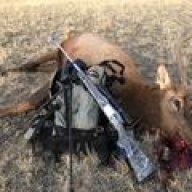
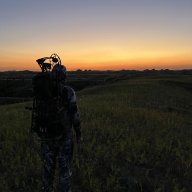
Elk aren’t armor-plated, a good bullet in the lungs will kill then about as fast as any other cervid.
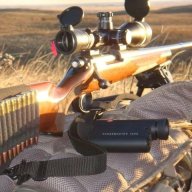
You will never wish your rifle was heavier, you may cuss its current weight wishing it were lighter.
Couple sets of comfortable/broken-in boots is advisable as IME, “Camping” never allows stuff to dry well.
I prefer merino base layers to synthetics. For me I feel like I’m covered for a much wider range of temp and activity w/Merino.
Glass, glass, glass, then glass some more. Don’t look for “whole elk”. Look for the nearly white rump and/or horizontal and vertical lines out of place and study them.
I prefer to “train” with a pack other than the one I’ll hunt in so I don’t spend all summer pouring gallons of sweat into my hunting pack.
Bags of kitty-litter spread weight out similar to how it will be hauling meat. Getting close to “go-time” you can add a 2nd or 3rd bag, they’re durable and easy to pack together.
If you’ve managed to ambush elk without them knowing where you are, IME, elk rarely take off @ the 1st shot. They want to make darned sure they’re not running into danger and will stand and scan to figure out how to get away from danger. Elk are exponentially less skittish than a whitetail.
You can get an entire elk in a 120Qt cooler, I’ve done it a couple dozen times. If you’ve got the space, a 2nd large cooler is very nice so one can spread the portions out so they’ll cool faster.
If you’ve never boned out a critter on the ground, it’s really not that hard going the “gutless” route.
1. Stick the knife in between the ears and cut down the back-bone to the tail (stay out of the backstraps). Skin the “up” side down to the “elbow/knee”. You can “knuckle” the bottoms of the legs off w/just a knife. Peel off the shoulder, peel out the back straps, remove the rear quarter following the bone just as you would hanging (they’re shaped EXACTLY like a deer rear quarter, just larger, they peel away from the hip, pelvis, and femur just like a deer. Make a slit from the last rib to the hip socket and with a cut @ the front/back, you can literally peel out the tenderloins. Flip-repeat. Don’t forget to extract the ivory teeth if you leave the head behind.
Elk can be noisy, especially if you’re not. Rut will be over, but, bulls will still be chirping, you might hear some short bugles, and cows are ALWAYS “mewing”. Daybreak and dusk is when they’re the most vocal, that also when they’re in their feet and moving.
Secluded waterholes/seeps where an elk can get in/out without being spotted from a major trail/road is a good place to look for fresh sign and maybe keep an eye on.
I might think of more later.