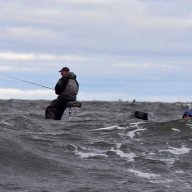
Musky VS Walleye battle in MN

MuskyManiac

Founding Member
Founding Member
Joined
Apr 23, 2015
Posts
3,660
Likes
195
Points
313
Location
Grand Forks, ND
You really think more ND people fish MN than the other way around? Oh boy...

I don't know exact figures, that's why I said I "venture to guess". I do know that MN sold around 230,000 non-resident licenses and North Dakota around 60,000. With as much as DL has been on TV for both summer and winter fishing there are people coming from all over the US to fish Devil's

I guess my whole point is that Minnesota is far from dead for walleye fishing. To think that thousands and thousands of anglers are running to North Dakota because they can't find fish in their own state is laughable.

- - - Updated - - -

you better cite your source.

I don't think there is any debate that walleye are spookier and harder to catch for the average fishermen in the daytime in clearer water.


DirtyMike

Founding Member
Founding Member
Thread starter
Joined
Apr 13, 2015
Posts
12,108
Likes
496
Points
453
Location
Bismarck, ND
I don't think there is any debate that walleye are spookier and harder to catch for the average fishermen in the daytime in clearer water.

Yeah, no disagreement there. I was pointing out the fact that Lycan's paragraph was copied and pasted from the article, verbatim, so I was being ironic in asking him for his sources. Poor attempt at humor via written word.
 

guywhofishes

Founding Member
Founding Member
Joined
Apr 21, 2015
Posts
30,182
Likes
8,780
Points
1,133
Location
Faaargo, ND
Yeah, no disagreement there. I was pointing out the fact that Lycan's paragraph was copied and pasted from the article, verbatim, so I was being ironic in asking him for his sources. Poor attempt at humor via written word.

I got it and chuckled. Hope that helps.


MuskyManiac

Founding Member
Founding Member
Joined
Apr 23, 2015
Posts
3,660
Likes
195
Points
313
Location
Grand Forks, ND
Yeah, no disagreement there. I was pointing out the fact that Lycan's paragraph was copied and pasted from the article, verbatim, so I was being ironic in asking him for his sources. Poor attempt at humor via written word.

Oh, I got it now. My bad.

I actually hope the DNR does a good population study of all the fish in Pelican very soon so we can see a comparison of numbers from the past. That might settle some people down......but probably not.

- - - Updated - - -

Here's an article that talks a bit about musky density, which a lot of non-musky anglers just don't understand and is a large part of the confusion on their stocking. Comparisons to northerns are just not accurate and not fair. There is a reason they are called to fish of 10,000 casts. I've fished a fair amount this summer and have caught 3. This article states Lake Bemidji, which is around 6,500 acres may only have 500-600 adult musky in its waters, and it's considered one of the premier lakes in the state.


http://www.twincities.com/outdoors/ci_25914335/minnesota-muskies-growing-huge-but-numbers-falling


When Minnesota muskie anglers take to the water this weekend, they'll be chasing bigger and bigger fish -- but apparently less and less of them.
That's the emerging suspicion of state biologists monitoring populations on a number of Minnesota's roughly 100 lakes with strong populations of muskellunge. What they've seen is that as the population of muskies ages and fish grow larger -- a trend almost certain to continue as the state adopts a 54-inch statewide minimum next year -- densities of muskies are falling.
The phenomenon -- suspected to be the result of big muskies eating smaller ones -- is eye-opening to researchers because numbers of the fast-growing, voracious fish are naturally low to begin with.
For example, 6,581-acre Lake Bemidji is now believed to have a mere 500 to 600 adult muskies in it, according to a two-year population estimate completed last month by the Department of Natural Resources. "You'd think there'd be room for more than that," said Gary Barnard, the DNR's Bemidji area fisheries supervisor.
But the good news for trophy seekers: Those fish are huge.
"There are a lot of 'em, a lot of really big muskies," Barnard said. "A lot of fish over 50 inches."
In the second half of May, DNR electrofishing crews examined 80 muskies in spawning grounds of Lake Bemidji. As to be expected, most were males, but a number of them were "approaching 50 inches," Barnard said. That's a monstrous size for male muskies, the females of which are larger and generally seen as the prizes. Of the females caught, roughly 1 in 4 was longer than 50 inches, Barnard said. The biggest weighed 46 pounds.
"We started seeing this last year on Bemidji, and we were surprised by the size distribution," he said. "So this year we spanned the entire spawning period to make sure we weren't doing something that was biased toward capturing bigger fish. We found the same thing this year: A lot of these fish are big."
In other words, the lake has no problem growing healthy, long-lived, enormous fish, but it might be at the cost of total numbers of fish.
Barnard doesn't believe there's anything wrong with what's happening, but he said he hopes anglers this season -- which started Saturday -- understand that they may see less "action" from 35-inch to 45-inch fish -- because there appear to be less of them in many waters than a decade ago.
That jives with what the log books of muskie guides and online bragging boards of muskie groups have been showing for several years, said Shawn Kellett, vice president of the Twin Cities Chapter of Muskies.
"Catch rates are going down across the board," Kellett said. "This is real."

LOW DENSITIES
An old adage of muskie anglers held that a body of water could support one adult fish per acre. In the past few decades as musky fishing, stocking and studies have surged, biologists have come to believe densities of healthy muskie populations are lower than that. Fish are often stocked at one fish per littoral acre. The littoral zone refers to fertile waters generally shallower than 15 feet deep where most aquatic plants, spawning habitat and young fish are located.
Lake Bemidji has about 1,860 littoral acres and is stocked every other year with about that many fish -- fingerlings large enough to have high survival rates. Yet the population of 500 to 600 suggests a density of less than one fish per 100 acres, or one for every three or so littoral acres.
Bemidji is considered a "restored" muskie lake. Natural reproduction occurs, but it's limited, and the DNR continues stocking to supplement the population. In theory, stocked fish should fill in during "off" years when natural reproduction, for whatever reason, is low.
Yet, it appears that the majority -- two-thirds or so -- of the stocked fish aren't surviving to adulthood.
The phenomenon isn't isolated to the largest of Minnesota's roughly 100 muskie waters. "It's a pattern," Barnard said.
For example, 300-acre Elk Lake in Itasca State Park has received roughly 150 muskies annually for years. Current population estimate: 50 adult fish. The DNR uses the population as a brood stock to gather eggs for its stocking program, so biologists are familiar with its population and study it closely.
"That's just not a lot of fish," Barnard said. "The notion that these lakes are full of fish is just not true."

CANNIBALISM?
Here's what the DNR thinks is happening:
When major stocking efforts of pure strain muskies started on many lakes two decades ago or sooner, the fish had little competition from larger muskies, and they survived well.
"They filled a void," Barnard said. "We probably went through a period of higher abundance from introduction by stocking."
Then, as some fish grew huge -- more than 50 pounds on some waters -- the populations appear to be stabilizing at lower levels.
It's called "recruitment suppression," and it happens with many fish. Sometimes there isn't enough spawning habitat or food in a lake to support a population that boomed after being introduced. But that doesn't appear to be the case with muskies.
So what's happening to them? With no signs of disease or other cause of mortality, the most likely explanation is they're being eaten by other muskies.
"That seems to be the case," Barnard said, "and it's made us wonder amongst ourselves."
The notion that 500 or so muskies could find so many of their kind on a large lake like Bemidji -- a lake with an ample population of ciscoes, the muskies' preferred forage -- suggests that the fish might concentrate their feeding in ways scientists don't understand.
It also might have ramifications as the DNR moves forward with plans to re-work northern pike regulations over the next few years. Among the goals is to grow huge northern pike, which are disappearing throughout Minnesota, on lakes capable of producing them.
"We don't really know what these climax pike populations looked like," Barnard said. "We know the fish were there, and we've always thought they were fairly abundant, but maybe they weren't. And maybe really large pike are able to keep smaller pike in check the way it looks like muskies are doing. We're learning from both species."

ALTERNATE THEORY
It's possible the data is wrong, and muskie populations haven't actually fallen as the fish have aged and grown.
Barnard said that would be true if the DNR was missing fish in their spring population assessments. The only reason they would be missing fish is if the fish weren't coming in shallow to spawn. And the only reason that would be is if they were delaying their sexual maturity so they could grow bigger.
The theory is that, say, 50-inch-plus females might have a spawning advantage over 45 inchers, and that might cause the 45 inchers to delay putting energy into making eggs until they're larger. Male bluegills exhibit this behavior, but it's never been documented in muskies. And it would be hard to confirm, Barnard said, because muskies are notoriously hard to capture outside spawning areas in significant numbers.
Meanwhile, the state is moving toward managing its muskie population to become essentially a catch-and-release fishery with the goal of growing the biggest fish possible. Last month, Gov. Mark Dayton signed legislation to increase the statewide minimum to 54 inches on most inland waters, up from 48 inches currently.
Kellett doesn't believe the increased minimum, which he and other muskie advocates lobbied for, will have much bearing on the apparent falling numbers of fish, but he said the muskie community is watching closely.
"There's a lot of consternation in the muskie world right now," he said. "We're seeing a lot of these lakes crash, and then we see the DNR pull stocking back to see if there's natural reproduction. The DNR did a great job creating a world-class muskie fishery, but now we need to maintain it.
"There's a lot going on that we don't know about muskie populations. I'm a little hesitant to say this is happening or this is not happening."
Not that any of this will alter the summer plans of devotees of the muskellunge, fabled to be "the fish of 10,000 casts."
 

johnr

Founding Member
Founding Member
Joined
Apr 24, 2015
Posts
21,636
Likes
7,678
Points
948
Location
Dickinson
I don't know exact figures, that's why I said I "venture to guess". I do know that MN sold around 230,000 non-resident licenses and North Dakota around 60,000. With as much as DL has been on TV for both summer and winter fishing there are people coming from all over the US to fish Devil's

I guess my whole point is that Minnesota is far from dead for walleye fishing. To think that thousands and thousands of anglers are running to North Dakota because they can't find fish in their own state is laughable.

- - - Updated - - -


I don't think there is any debate that walleye are spookier and harder to catch for the average fishermen in the daytime in clearer water.

Of the 230,000 out of state licenses MN sold, how do we know they all came from ND. Just like we would never know the 60,000 out of state ND tags came from MN.

I lived in Fargo for 31 years, I bought 5 seasons of MN licenses in those 31 years. I decided that my state was more deserving of my money, and fished all over ND for most of my eastern life. I enjoy lake of the woods, leech lake, and millacs too. But they have little more to offer than any of my ND waters do.

If I lived in MN I would likely fish MN exclusively too.

But more to your point I am sure the little Minneapolis area has a ton of ND'rs that have cabins in western MN and purchase a sizeable amount of them out of state licenses, but I would guess most guys who don't have a place in the state are rushing over when their "seasons" open. Just guessing though, as the friends I still have in Fargo, ND (all 6 of them) don't fish over in MN.
 

MuskyManiac

Founding Member
Founding Member
Joined
Apr 23, 2015
Posts
3,660
Likes
195
Points
313
Location
Grand Forks, ND
Correct, johnr, we've had a place on Lida for many, many years. I was born and raised in ND and so was my father, but he used to go to Lida as well when he was a kid.

I've been to Pelican (Devil's Lake) and caught some nice fish. I even used to have a spot in a campground on Dead Cow Bay until kids were born, and I've had the 100 walleye days. But to me, there is nothing better than catching multiple species of fish surrounded by awesome scenery, with fun places to go eat and drink. Devil's just doesn't do it for me in that regard.
 

guywhofishes

Founding Member
Founding Member
Joined
Apr 21, 2015
Posts
30,182
Likes
8,780
Points
1,133
Location
Faaargo, ND
Just guessing though, as the friends I still have in Fargo, ND (all 6 of them) don't fish over in MN.

We thought you had made new friends who DO fish in MN.
heartbroken.jpg
 

johnr

Founding Member
Founding Member
Joined
Apr 24, 2015
Posts
21,636
Likes
7,678
Points
948
Location
Dickinson
Correct, johnr, we've had a place on Lida for many, many years. I was born and raised in ND and so was my father, but he used to go to Lida as well when he was a kid.

I've been to Pelican (Devil's Lake) and caught some nice fish. I even used to have a spot in a campground on Dead Cow Bay until kids were born, and I've had the 100 walleye days. But to me, there is nothing better than catching multiple species of fish surrounded by awesome scenery, with fun places to go eat and drink. Devil's just doesn't do it for me in that regard.

I know you did mm we went to high school together, class of '88 go bruins...haha. We didn't hang out to much, but went to a few of the same parties. I remember your nick name, it rhymed with your last name, well sorta.

My old man had a place on sally, however was gone before I was old enough to really enjoy it. He doesn't even fish anymore, and actually sold all his guns.


johnr

Founding Member
Founding Member
Joined
Apr 24, 2015
Posts
21,636
Likes
7,678
Points
948
Location
Dickinson
We thought you had made new friends who DO fish in MN.
heartbroken-1.jpg

This is true, but when the chips fall as to who I was hanging with in MN, I deny knowing anything about any of it...haha

- - - Updated - - -

Act like a liberal politician, and short answer my way right out of all of it. Then blame #guywhotalkedmeintocrossingtheriver.
 

guywhofishes

Founding Member
Founding Member
Joined
Apr 21, 2015
Posts
30,182
Likes
8,780
Points
1,133
Location
Faaargo, ND
internet "friends" don't count.

but... we broke bread and supped wine (OK - beer, but pretty much same sacred deal)

- - - Updated - - -

This is true, but when the chips fall as to who I was hanging with in MN, I deny knowing anything about any of it...haha

- - - Updated - - -

Act like a liberal politician, and short answer my way right out of all of it. Then blame #guywhotalkedmeintocrossingtheriver.

Shattered_world_copy_2-1.jpg
 

shorthairsrus

Founding Member
Founding Member
Joined
Apr 13, 2015
Posts
8,877
Likes
769
Points
508
Lida lake association stocked fingerlings and then beat dnr half to death to get size restrictions in place. If they would not of done that it would of been added to long list of exhausted lakes in mn. Keep in mind the dnr imposed bass and crappie regs before the walleye regs
 

MuskyManiac

Founding Member
Founding Member
Joined
Apr 23, 2015
Posts
3,660
Likes
195
Points
313
Location
Grand Forks, ND
I know you did mm we went to high school together, class of '88 go bruins...haha. We didn't hang out to much, but went to a few of the same parties. I remember your nick name, it rhymed with your last name, well sorta.

I remember, johnr. Any time you want to fish musky in MN you just let me know.


shorthairsrus

Founding Member
Founding Member
Joined
Apr 13, 2015
Posts
8,877
Likes
769
Points
508
Contrary to what the DNR says in its news release, muskies can cause significant problems to existing walleye and other fish populations. The DNR and some pro-muskie folks say any such concerns are mere "myth" and "misconception". That’s what they want you to think. Don’t be misinformed. Here are some facts...


Studies done in the States of Wisconsin and Michigan have shown that in some lakes muskie populations have exploded and decimated existing fish populations. More on those specific studies below, but the Minnesota DNR says muskies simply want to eat soft-spined suckers and leave the rest alone. This is not the truth. The truth is muskies eat suckers and whatever else they need to survive. Many of us prefer steak, but we, like muskies, don’t always get what we want, so we eat to survive.

THE SCIENCE THE DNR IGNORES

Some say Minnesota has replaced Wisconsin as the Mecca of muskies. That may be true, and according to Thomas Sommerfeldt, a Senior Fisheries Biologist from the Wisconsin DNR, many of the Wisconsin muskie lakes have "new unprecedented muskie densities" and have "eaten themselves out of house and home." Sommerfeldt states that while muskies do like white suckers, "once they run out of white suckers you have problems." In an ongoing study by Sommerfeldt that is in draft form he writes, "I conclude that muskellunge predation can have a severe effect on resident fish populations." His conclusions were based on different lakes. In the case of Lower Clam Lake, as the muskie population peaked, the walleye population tanked from 3.3 fish per acre to 0.8 per acre despite walleye stocking efforts. In Butternut Lake the conclusion was, "muskellunge predation would rank as the number one cause of walleye mortality in . . . 1998." The problems with muskies on Butternut have gotten so far out of control that fisheries biologists are proposing to "mechanically remove 500 adult muskellunge under 38 [inches]" in the near future." Additionally, there is a recommendation to "encourage some angler harvest of muskellunge less than 40 [inches]" long." Sommerfeldt was frank in a phone interview. He stated, "it’s frustrating as heck trying to educate those who do not want to acknowledge that "increased densities [of muskies] are going to impact our fish populations."


In a 1984 study on Sparkling Lake in Wisconsin, the author, John Lyons, concluded, "Coupled with the lack of any other obvious causes of the observed population declines, it seems plausible that muskellunge predations had a major impact on the density of adult walleyes in Sparkling Lake during the early 1980’s."


Crappies as well as walleyes are popular fish in Gull and other Minnesota lakes. In Michigan a study by the DNR showed that as muskie populations rose, black crappie populations crashed. In Iron Lake, muskies were stocked starting in 1962 and white suckers and black crappies were abundant, however, by 1979, "black crappies and white suckers continued to be scarce." The study concluded, "with the advantage of hindsight two lessons to be learned from this

management experience are: carefully consider beforehand all the possible consequences of any major change imposed on a fish population and intensely monitor any fish populations being subjected to novel management techniques." Muskies are not native to Brainerd area lakes and from this writer’s perspective novel is a good adjective for the proposal to stock muskies where they don’t exist and where walleyes, crappie and northern pike are the fish of choice.

There are more studies, but they are not being considered by the DNR. In its recent News Release the DNR states, "there is no research evidence that suggests introducing muskellunge into a lake has caused corresponding decrease in the walleye fishery." It does not take a DNR fisheries biologist to know that the DNR is wrong and gambling with our lakes. To read these and other studies go tomusky-studies-facts.

 

MuskyManiac

Founding Member
Founding Member
Joined
Apr 23, 2015
Posts
3,660
Likes
195
Points
313
Location
Grand Forks, ND
Lida lake association stocked fingerlings and then beat dnr half to death to get size restrictions in place. If they would not of done that it would of been added to long list of exhausted lakes in mn. Keep in mind the dnr imposed bass and crappie regs before the walleye regs

And those restrictions were just renewed for another 10 years this spring.
 

Lycanthrope

Founding Member
Founding Member
Joined
May 6, 2015
Posts
7,068
Likes
2,370
Points
758
Location
Bismarck
Nice thing about MN is if you dont like the fish on one lake, its a 5 mile drive to a different one. Bunch of pansies....
 

MuskyManiac

Founding Member
Founding Member
Joined
Apr 23, 2015
Posts
3,660
Likes
195
Points
313
Location
Grand Forks, ND
Contrary to what the DNR says in its news release, muskies can cause significant problems to existing walleye and other fish populations. The DNR and some pro-muskie folks say any such concerns are mere "myth" and "misconception". That’s what they want you to think. Don’t be misinformed. Here are some facts...


Nice copy and paste from www.muskytroubles.com!

You don't think they're biased at all, do you shorthairsrus? :::

Always the same arguments that just don't hold up to most of the facts and science out there. Sure, you can always find something to support any argument, but time and time and study after study shows musky and walleye get along just fine.

From what I can tell you fish Devil's all the time. Have you fished Pelican (MN) for walleye? Have you fished anywhere in MN for musky? Perhaps if walleye anglers practiced more catch-and-release they wouldn't have to blame other fish and other fishermen for their problems. What happens when Devil's Lake declines and there are no musky to blame?!?!?!
 

shorthairsrus

Founding Member
Founding Member
Joined
Apr 13, 2015
Posts
8,877
Likes
769
Points
508
My point with lida is that one needs to question the dnr and the lake association did so and the fishery responded.. .not that I am against muskullenge


Recent Posts

Friends of NDA

Top Posters of the Month

  • This month: 213
  • This month: 63
  • This month: 50
  • This month: 50
  • This month: 45
  • This month: 36
  • This month: 28
  • This month: 27
  • This month: 26
  • This month: 25
Top Bottom